I thought I had a pretty clever idea.
Chapel Hill Woodturners was looking for a few higher-end pieces to sell at upcoming events to raise money for the club. Meanwhile, I'd been thinking about entering a bowl in the North Carolina State Fair. I'd won third place in the hobbyist division a couple of years earlier, and I was ready to try my luck in the professional division.
Why not kill two birds with one stone: Make a competition-worthy bowl, then donate it to the club to sell.
There was just one complication.
I'd noticed that State Fair judges seemed to favor more elaborate constructions—laminated designs, intricate glue-ups, and other technically ambitious pieces. Not exactly my usual approach to woodturning. I tend to let the form and the wood do the talking, and engineering a complicated laminated blank was decidedly outside my comfort zone.
Fortunately, I knew someone who could help.
Frank Penta.
I'd already talked with the club's sales leadership about my idea, and they were supportive. So I sent Frank a text explaining what I had in mind and asking whether he'd be willing to help me make the blank.
And waited.
And waited some more.
As the State Fair deadline grew closer, I began contemplating the increasingly alarming possibility that I might have to engineer this thing myself.
Eventually, I got in touch with Frank, who responded in typical Frank fashion: essentially, Yeah, Pal. Whatever you need.
Of course he would help.
We traded a few design photographs, and I arrived at his shop with a fairly clear vision of what I thought might catch the judges' attention.
We spent the first 30 or 45 minutes discussing possibilities. I even sketched my design on his blackboard. Frank showed me some of his own designs, and eventually we settled on one of his suggestions.
It wasn't what I'd originally envisioned, but that was rather the point of the exercise. I wanted to explore something different, learn some new techniques, and see what happened.
So I decided to lean in.
What I didn't realize was that I'd just committed myself to six separate glue-up sessions.
Six.
Frank had explained the construction process, but apparently I hadn't fully appreciated what I was agreeing to. There were strips of wood to glue together, blocks to cut apart, patterns to rearrange, more glue-ups, more cutting, and more glue-ups.
And clamps.
So many clamps.
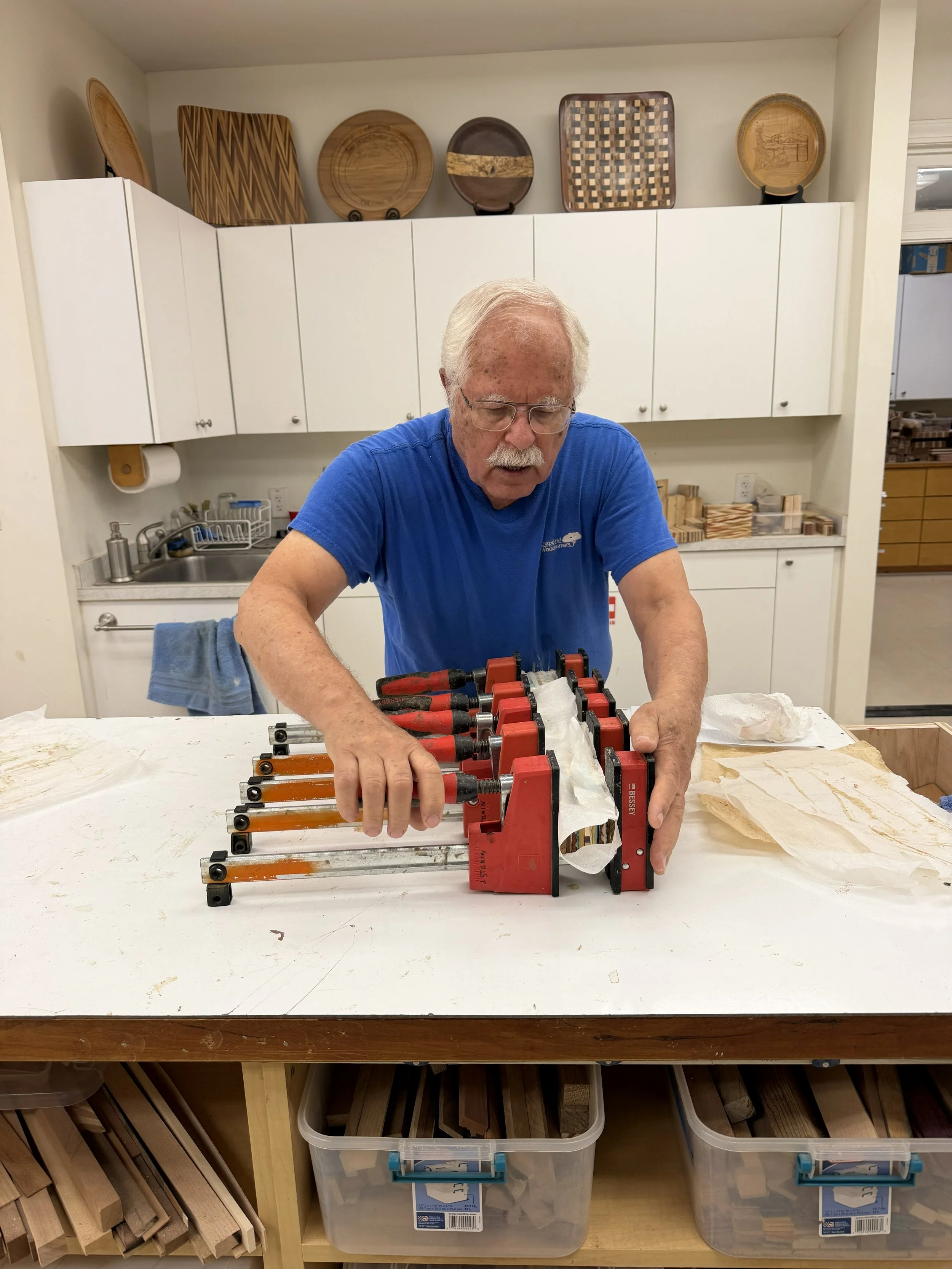
Frank checking the clamps. There were plenty to check.
I'm rather glad I didn't understand the full scope of the project beforehand. I'm not entirely sure I would have agreed to it.
Frank generously supplied the wood and other materials, along with the use of his shop, equipment, and considerable expertise. Together we constructed the blank, and after those six sessions, I could finally get down to the business of turning it.
I started shaping the exterior at Frank's shop, then brought the blank home to finish turning it on my own lathe.
Even that required some unfamiliar mental gymnastics.
The design included carved feet, which meant I needed to approach the bottom differently than I normally would. Instead of my preferred tenon and compression chucking, I had to use a recessed mounting arrangement—not my usual choice. Frank's response to my hesitation? "We don't avoid things we aren't comfortable with. We learn how to do them."
Frank loaned me one of his bowls as a reference, and I spent a fair amount of time trying to visualize where the feet would eventually emerge.
I was more than a little apprehensive about carving them.
Naturally, when I returned to Frank's shop to learn how, they turned out to be surprisingly easy.
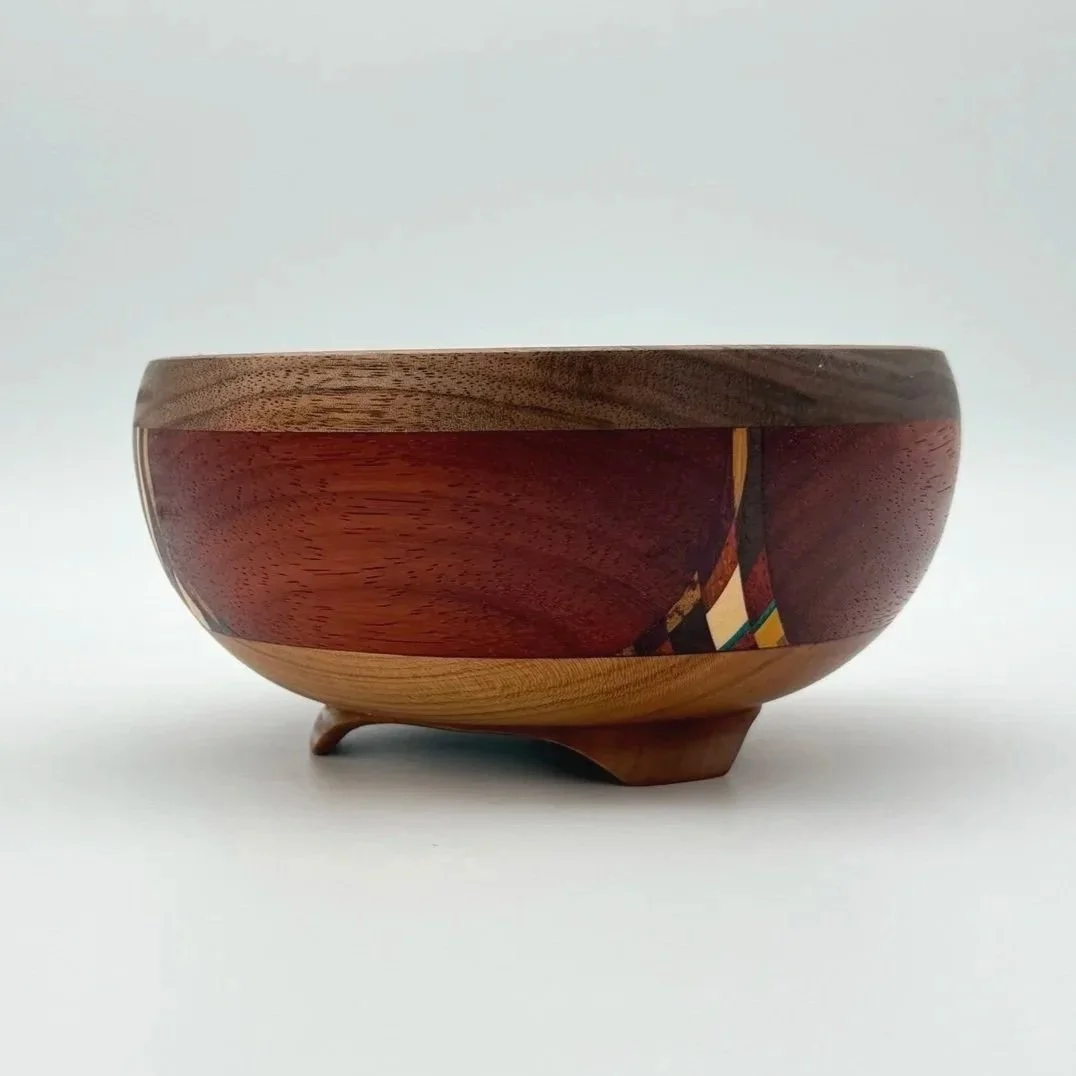
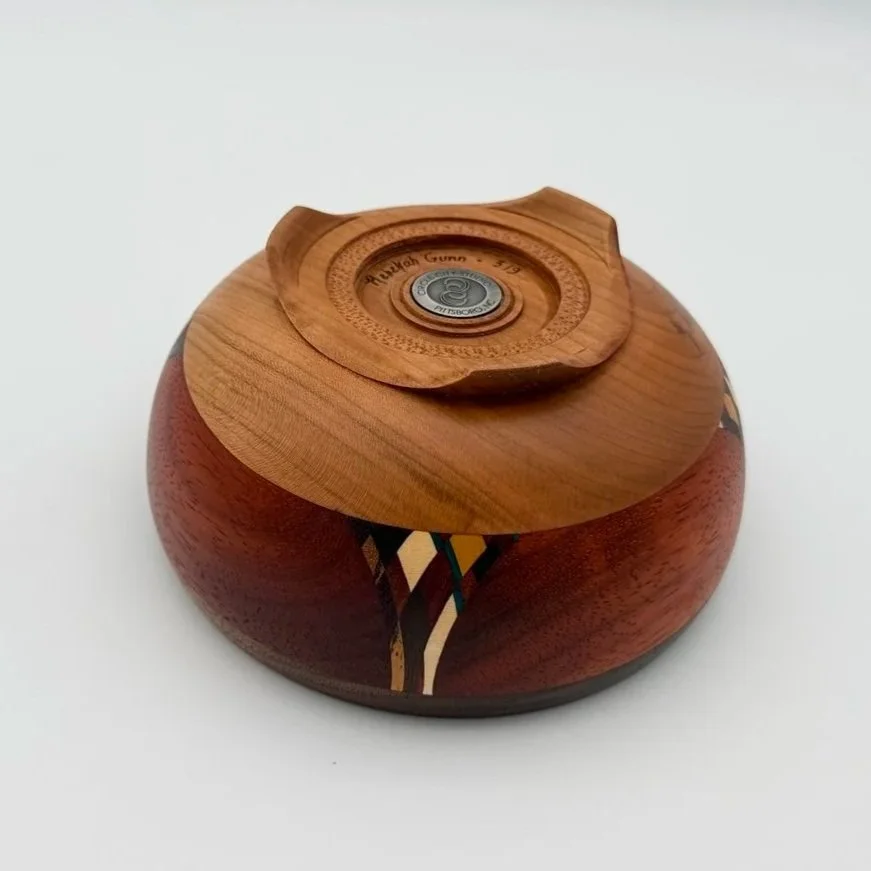
The feet were easier to carve than they were to contemplate.
After some final sanding and an application of a tung oil blend that our club mixes ourselves, the bowl was complete.
And I had to admit, it was attractive.
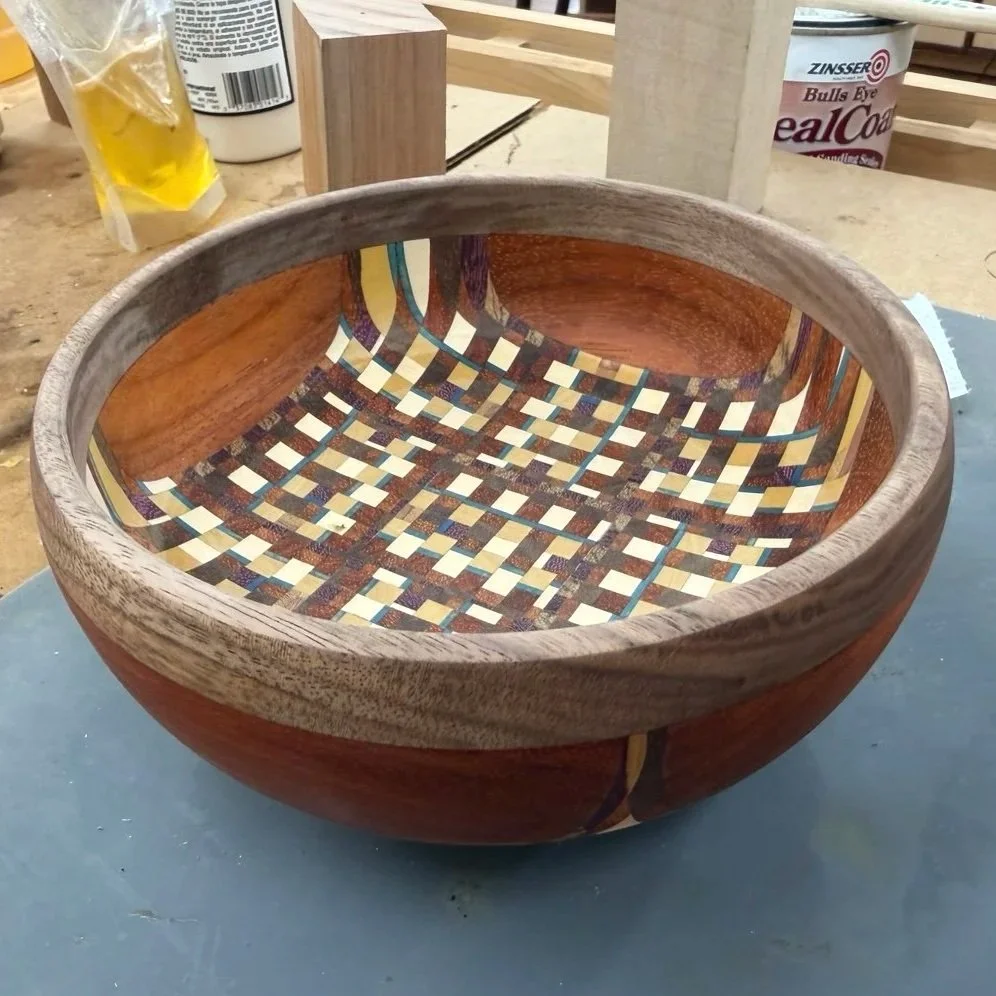
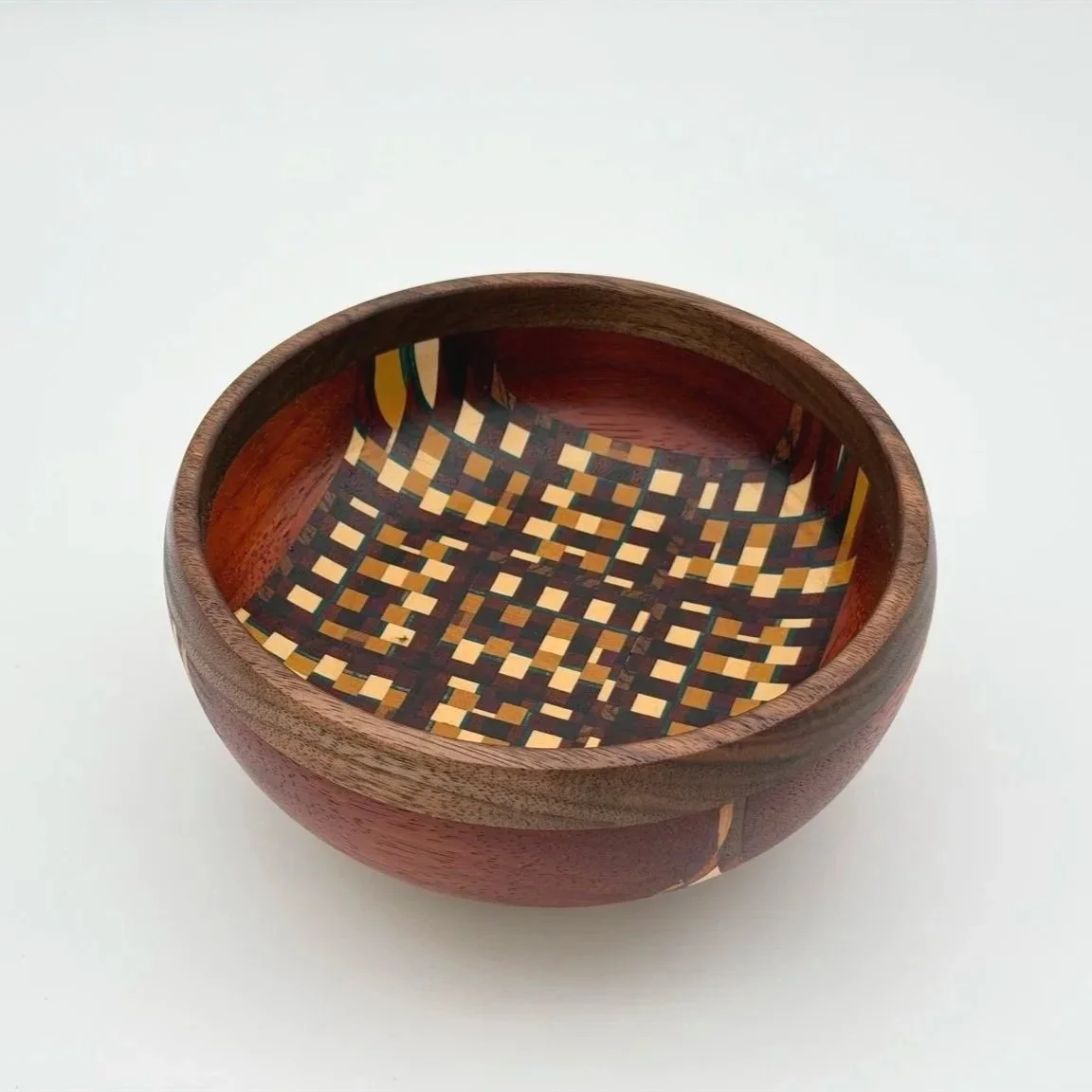
Six glue-up sessions later.
It wasn't the style that I ordinarily gravitate toward, but I could appreciate the result.
More importantly, I could already see possibilities for revisiting some of these techniques in ways that felt more like my own artistic voice.
Even the feet. Especially the feet.
I was headed to the western part of the state the day the bowl was due at the State Fair, so my friend Myra (fellow woodturner and beekeeper!) braved the zoo of competition entry drop-offs and delivered the bowl for me.
And then came the judging.
Second place. Professional Division. Wood Worked on the Lathe.

The judges weighed in.
When I visited the fair, I went looking for the woodturning exhibit. An attendant noticed me searching and asked whether I was looking for a particular person.
"ME!" I replied.
He showed me where to find my entry, and I asked whether he would mind taking my picture with it.
Not only did he agree, but he reached into the display and handed me the bowl.
"I actually get to touch my own bowl?!"
Apparently, after weeks of making it, I'd forgotten that I was allowed to hold the thing.
He took my picture (even prompting me to tilt it so the bottom could be seen!), complete with bowl and red ribbon, and I left with photographic evidence of a very satisfying experiment.
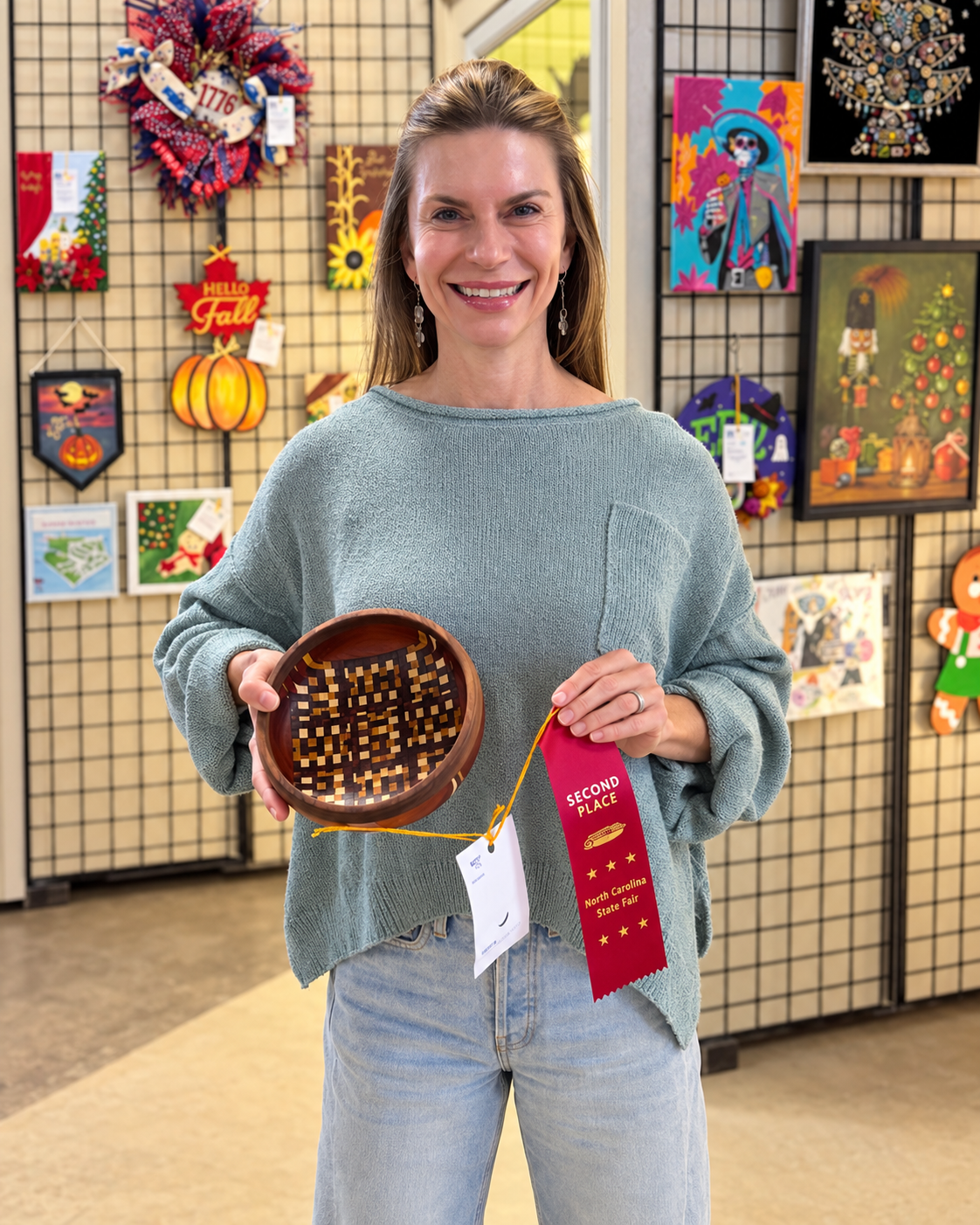
A very satisfying experiment.
The bowl's next stop is Cary Gallery of Artists for Final Friday, followed by the Pittsboro Street Fair the next day. If it doesn't find a new home at either event, it'll return to the gallery. Wherever it sells, I'll be donating my net proceeds to Chapel Hill Woodturners—fulfilling the original purpose of the project while giving the bowl an opportunity to find its next home.
As for what I learned?
Quite a lot, actually. About laminated construction, about carving feet, about working collaboratively, and about how much can happen when you're willing to try something outside your usual repertoire.
I'm already thinking about ways to incorporate some of those discoveries into future work.
And the State Fair?
I'll be back next year.
Red was my favorite color growing up.
These days, I rather like blue.