In 2022, I turned my first ornamental birdhouse. I was reasonably certain it would also be my last.
The Chapel Hill Woodturners had organized a workshop to make birdhouse ornaments for sale at the North Carolina Botanical Garden, with proceeds benefiting both organizations.
All raw materials were supplied: the body, the roof, the finial blank. All I had to do was turn the pieces and assemble them.
At the time, I was still getting acquainted with my spindle gouge, and the finished birdhouse reflected that relationship. It was okay. Not terrible, not spectacular, and not something I felt particularly compelled to revisit.
It felt more like a craft project than the kind of woodturning I was drawn to.
And that was that.
Or so I thought.
Of All the Things…
Fast-forward to late 2025.
Someone came across a photograph of that first birdhouse and contacted me about making two more.
Of everything I had made, everything this person could have chosen, they wanted that damn birdhouse.
Actually, they wanted two.
Naturally, I agreed.
There was just one small problem. I had made exactly one birdhouse in my life, roughly three years earlier, and someone else had handed me all the pieces parts.
This time I was on my own.
I had to source the branches, figure out how to cut and hollow the bodies, turn the roofs and finials, and work out how everything fit together.
Then there was the display stand.
The customer wanted a stand for each ornament, which meant designing and turning wooden bases, sourcing copper wire, determining the appropriate gauge, and figuring out how to bend it into a spiral that would support the birdhouse.
You might reasonably ask why I didn't simply consult someone who had done this before.
That's an excellent question.
I suppose there's a point in woodturning when you realize you've learned enough to figure things out for yourself. It doesn't necessarily mean you know what you're doing. It just means you're reasonably confident you'll figure it out eventually.
Somewhere along the way, the project acquired its own household hashtag: #ThoseDamnBirdhouses.
And then there were the birds.
Each ornament needed a tiny decorative bird perched near its opening. In the world of crafters, these are called mushroom birds, and the miniature versions were proving astonishingly difficult to find.
Nevertheless, I eventually located enough birds, completed both ornaments (admittedly, they were pretty dang cute), carefully packaged them, and sent them by three-day Priority Mail to their new home in Florida.
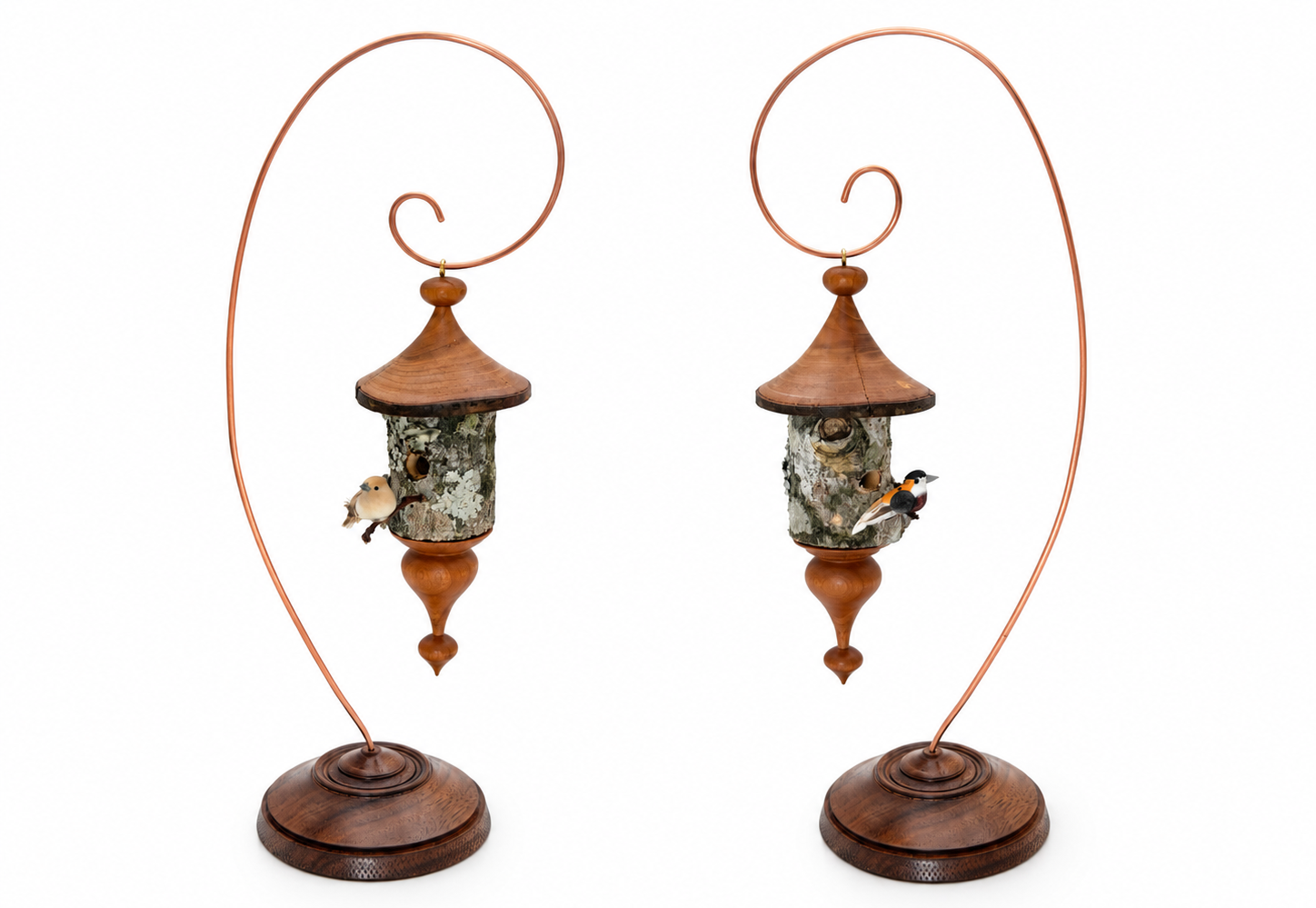
The Commissioned Birdhouses — 2025
Three days came and went.
No birdhouses.
Eventually, they resurfaced in Puerto Rico, where they spent approximately two weeks enjoying what I can only assume was an unexpected Caribbean vacation.
Thankfully, the Postal Service eventually redirected them to Florida.
My relief was considerable, particularly because, while the ornaments were missing, I had been contemplating the possibility of making two more.
#ThoseDamnBirdhouses, indeed.
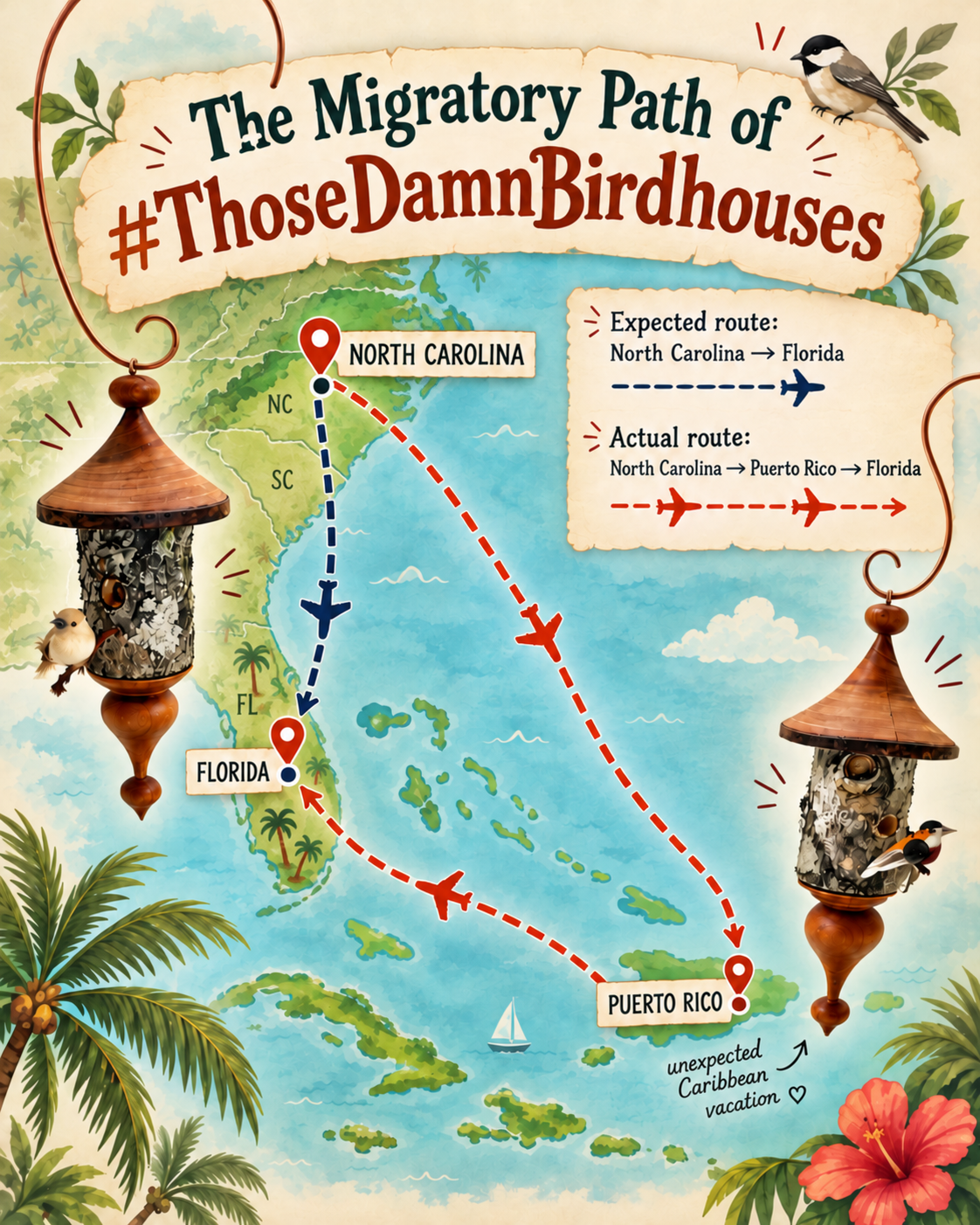
Apparently, nobody consulted the birds about their travel itinerary.
A Change of Perspective
Here's the interesting thing.
Despite the sourcing difficulties, the numerous components, and the unexpected shipping adventure, I hadn't actually disliked making the birdhouses.
What I disliked was making only two birdhouses.
With so many individual parts and processes, producing just a couple is remarkably inefficient. Creating an entire flock, on the other hand, is an entirely different proposition.
And now, as a member of the Cary Gallery of Artists, I have a holiday market to prepare for.
So I decided to give the birdhouses another go.
This time, I started preparing well in advance. I collected branches and cut them into short sections for the bodies, drilled the cavities, and set them aside. Larger branches were reserved for the roofs.
Rather than setting up for each operation twice, I could work through the components in stages: bodies, roofs, finials, wooden bases, and copper-wire stands.
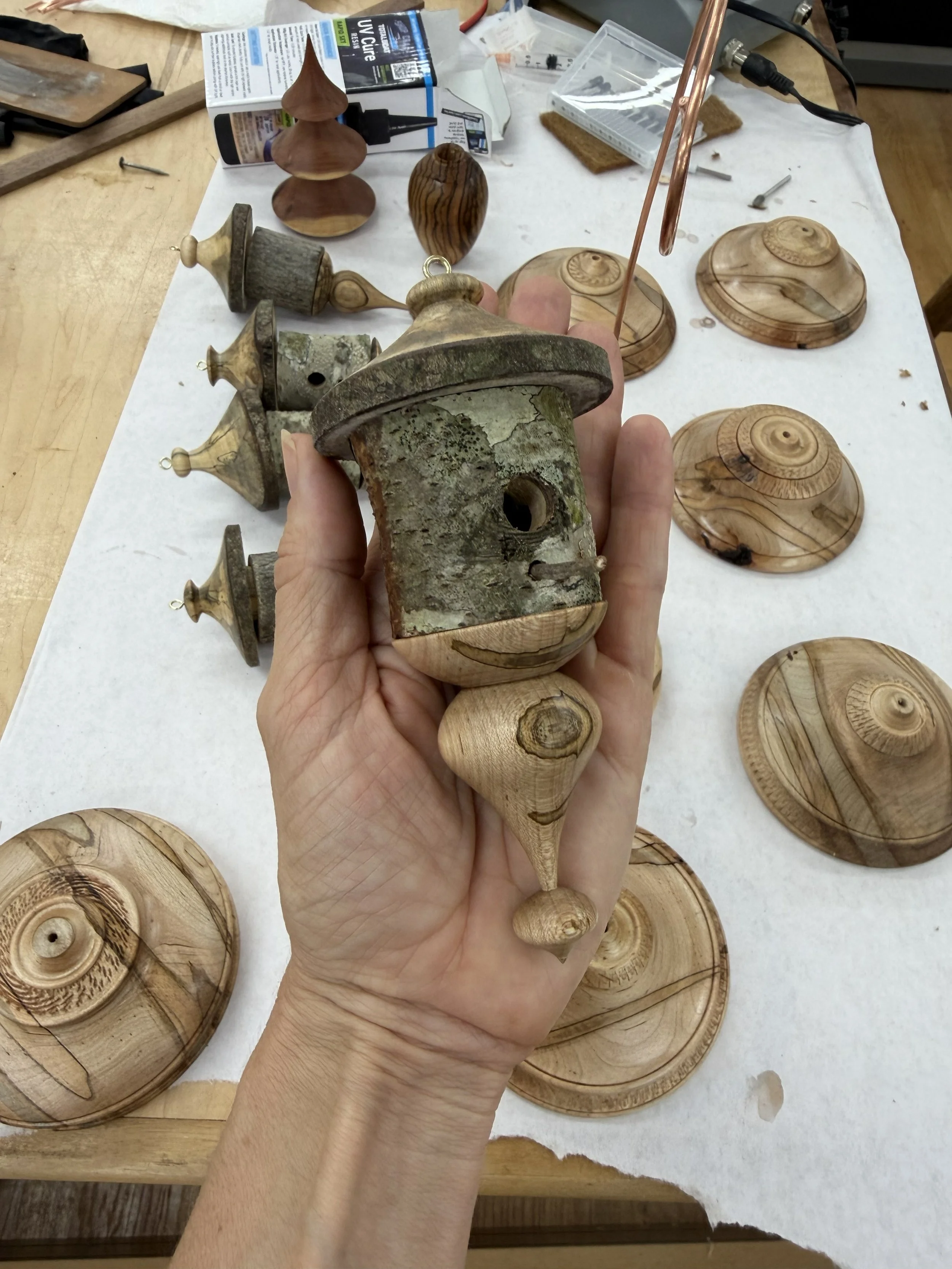
One birdhouse in hand, with the makings of a flock on the workbench.
There's something deeply satisfying about watching a collection of seemingly unrelated bits and pieces gradually become recognizable objects. And there's something comforting about the repetition. If one component isn't your greatest effort, there's another chance to get it right.
And having learned what worked—and what didn't—from those first two commissioned ornaments, I could refine the process and the design along the way.
The Great Micro Mushroom Bird Extinction
Unfortunately, my miniature bird problem has not improved.
Apparently, the micro mushroom bird has gone the way of the dodo.
Extinct. Vanished. An unfortunate casualty of whatever mysterious forces govern the international supply of tiny decorative birds.
Nobody seems able to explain why. I certainly can't.
I have managed to secure a small surviving population, but their future is uncertain.
Which brings me to the possibility of establishing my own captive breeding program.
I've been contemplating making the birds myself. Polymer clay is one possibility. Turning miniature wooden birds is another.
Neither is particularly convenient, but I've discovered that inconvenience sometimes leads to better ideas.
Recently, I accidentally blew out the lip of a hollow form during the final step of turning. What initially seemed like a ruined piece became an opportunity to redesign the opening, and I ended up liking the finished vessel better than my original plan.
I have a suspicion these elusive little birds may eventually present a similar opportunity.
In the meantime, the first birdhouse of the new collection has already migrated to Brasstown, North Carolina. The branches, copper wire, and turned components have all come together, but its perch remains optimistically vacant, awaiting a future inhabitant.
I never expected that first workshop birdhouse to lead anywhere.
Four years later, here I am, making them again—and contemplating whether I should start making the birds, too.
Please send birds.