
Her Turn:
How I Found Woodturning and Community
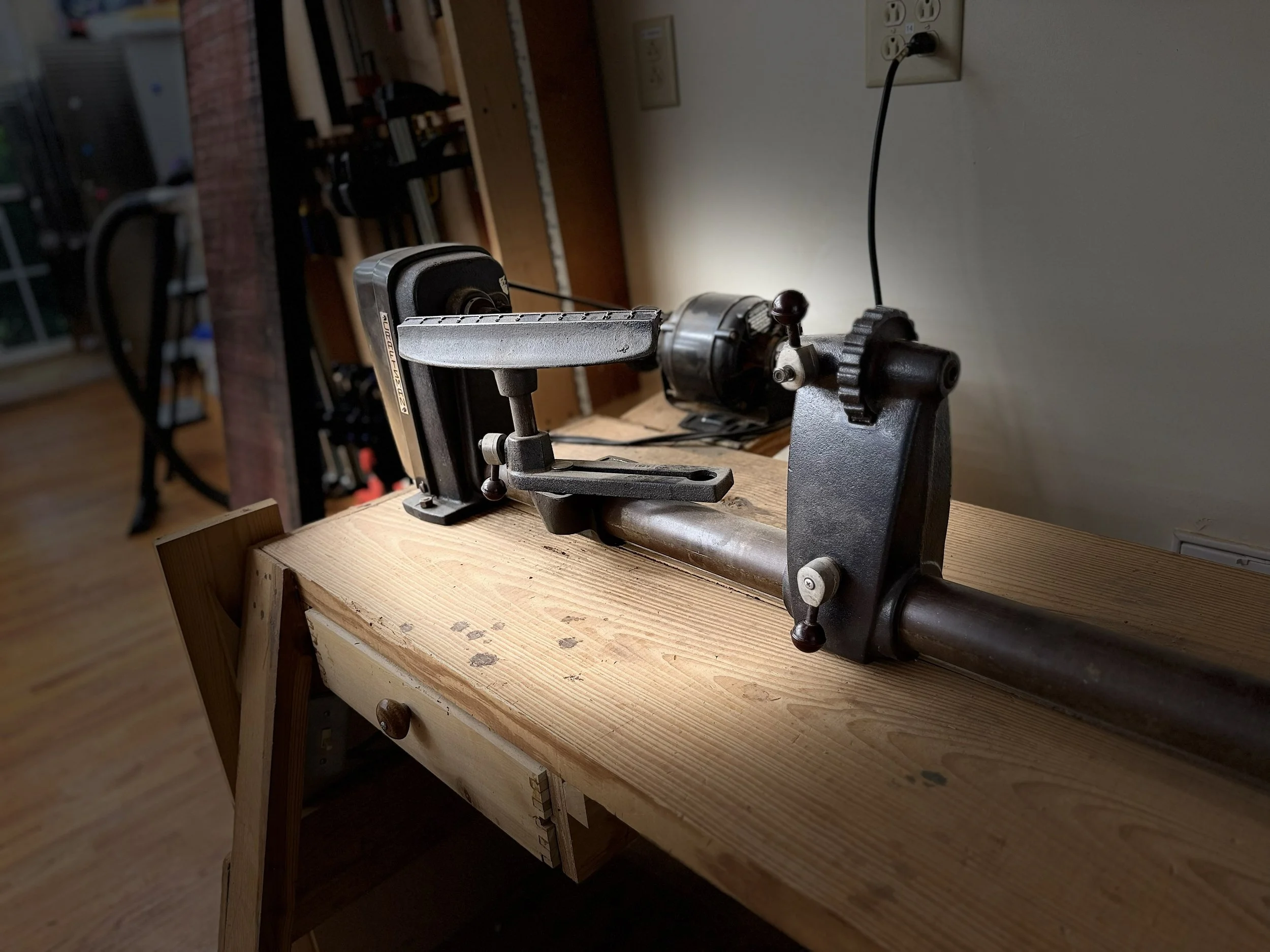
As I worked through the seemingly endless task of cleaning up my dad's workshop, there was one area that stood in stark contrast to the rest of the shop: his lathe.
While other drawers and cabinets were chaotically crammed full of tools, fasteners, and assorted whatnot in an organizational system understood only by my father, the drawers in the stand he'd built to support the lathe were almost eerily neat. Gouges and chisels were carefully arranged in one drawer. Calipers, rulers, and other measuring tools were laid out in another. Everything had a place.
I remember remarking on it to Mr. Pendergrast during one of our many conversations. Amid the randomness of a single shoe (in a size neither my mom nor I wore), old hardware and Spirits, and furniture my dad had built for me as a baby that had somehow found its way back into the workshop for storage, the order surrounding the lathe felt almost sacred.
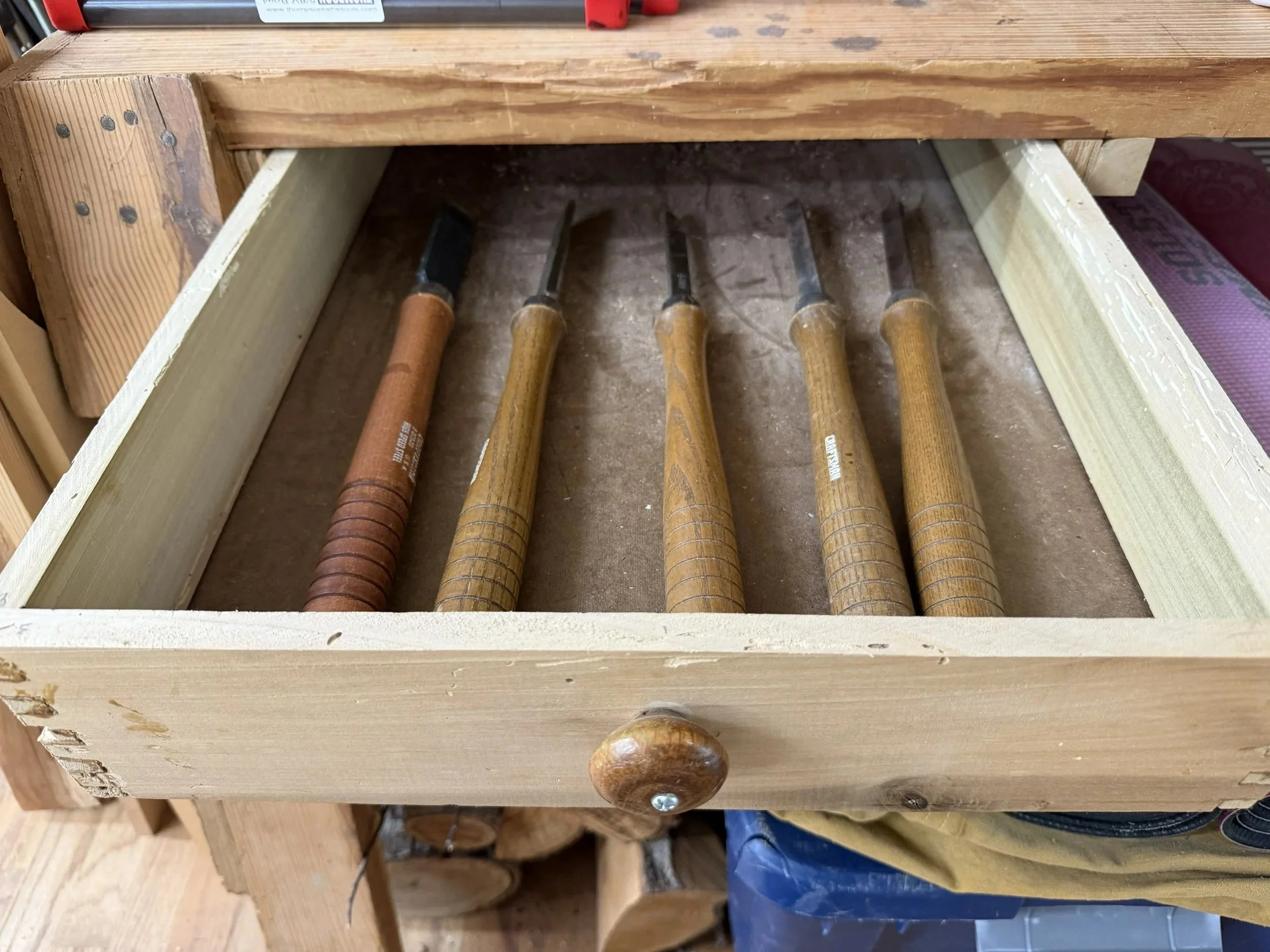
The lathe held a sense of mystery. Most of the machines in the shop didn't intimidate me too much. If I'd forgotten how to use something, I knew Mr. Pendergrast could get me back up to speed.
The Lathe was Different
Mr. Pendergrast had wisely stayed away from woodturning himself. His advice was simple: “Once you start turning, you don't stop.”
At the time, I laughed.
Now I know exactly what he meant. (He still likes to remind me that he warned me.)
It probably didn't help that my only previous experience with a lathe had ended rather dramatically. Back in high school carpentry class, a piece came flying off the lathe and hit me squarely in the head. Thankfully, my only real injury was to my pride...and yes, I cried. (Then again, maybe no one noticed but me. High school has a way of making you think everyone is watching.)
It never crossed my mind to sell my dad's lathe, but I didn't know how to use it and was more than a little afraid of it. I figured it was something I'd learn how to use...eventually.
At the time I began cleaning up the workshop, woodturning wasn't even on my radar. Beekeeping was my hobby. If I wasn't working or cleaning out the
workshop, I was probably tending bees or reading about them.
My beekeeping mentor, David Jones, also happened to be a woodturner, so one day I casually asked if he'd teach me how to use the lathe.
Looking back, I roll my eyes and chuckle at Me of the Past.
I had absolutely no idea what I was asking.
Woodturning isn't the sort of thing someone teaches you in an afternoon.
David Jones knew that.
Rather than volunteering for what would have been a very long-term commitment (out of sheer self-preservation, I'm sure), he pointed me toward the
Friday Learn to Turn sessions hosted by the Chapel Hill Woodturners.
Come On, Pal
So I loaded a few of my dad's gouges into my car and drove over, not knowing a single person and having no idea what to expect.
Frank Penta greeted me as though I'd been coming there for years. He put a hand on my shoulder and said, “Come on, Pal. We’ll get you set up on a
lathe.” (He calls everyone Pal.)
He walked me over to a lathe in the corner—which subsequently became “my” lathe for the better part of a year—and got me started with a pine blank and a
spindle roughing gouge.
Before long there were curls of fresh shavings collecting around my feet...and in my hair...and down my shirt. (IYKYK.)

The first time I used Dad’s lathe after starting at Chapel Hill Woodturners.
Somewhere along the way, without me even realizing it, the fear I'd carried since high school quietly disappeared. It was replaced by curiosity...and then delight.
I was hooked.
Sacred Fridays
What surprised me even more than the craft itself was the people.
Those Friday Learn to Turn sessions quickly became sacred time on my calendar. As a brand-new turner, I had the full attention of an entire room of
experienced woodturners. Talk about an incredible way to learn.
One of my favorite traditions was heading to Anna Maria's Pizza afterward. There isn't much conversation while a dozen or so lathes are running, so lunch was where everyone became more than instructors. It was where I got to know them as people.
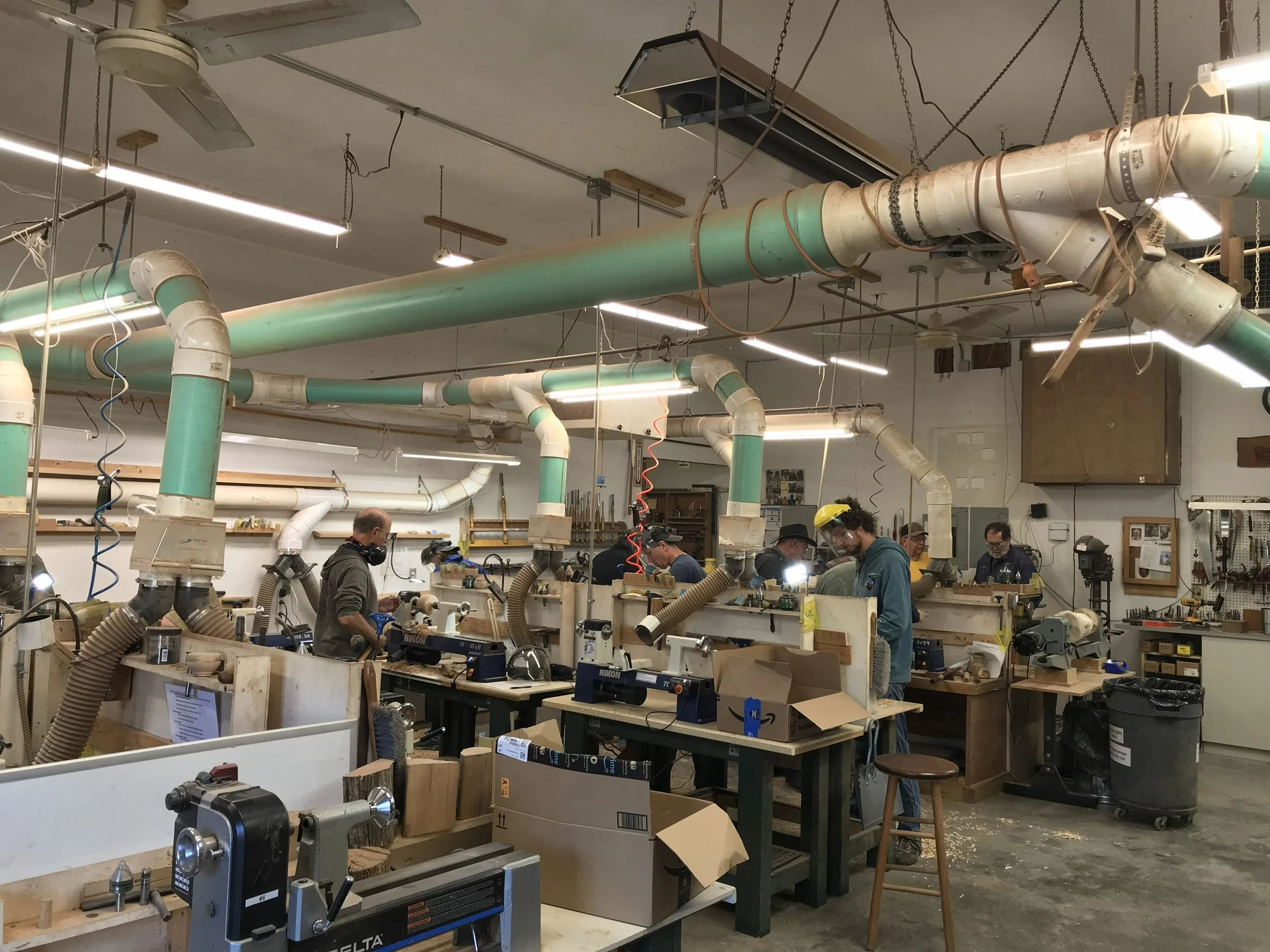
A busy Friday Learn to Turn session at Chapel Hill Woodturners.
Week after week, I learned far more than how to sharpen a gouge or ride a bevel. I found mentors. I found encouragement. I found people who celebrated
each other's successes and showed up when someone needed help. Somewhere along the way, those Friday afternoons stopped feeling like a class and started
feeling like belonging.

Years later, Frank is still one of the people I turn to for a second set of eyes.
“It’s what Chapel Hill Woodturners do: We help.”
And they do.
What started as an attempt to learn enough about my dad's lathe to be able to use it without fear of death and dismemberment turned into something I
never could have imagined.
It gave me a creative outlet. It connected me to my father's memory in a way I hadn't expected. And somewhere along the way, I realized I wasn't just
learning to turn wood. I was rediscovering a part of myself that had been quietly waiting for years.
Perhaps most importantly, I found a community that became my chosen family.
I'm grateful to David for pointing me in the right direction, to Frank for making a nervous beginner feel like she belonged there, and to the Chapel Hill Woodturners for doing exactly what Frank said they do.
They helped.